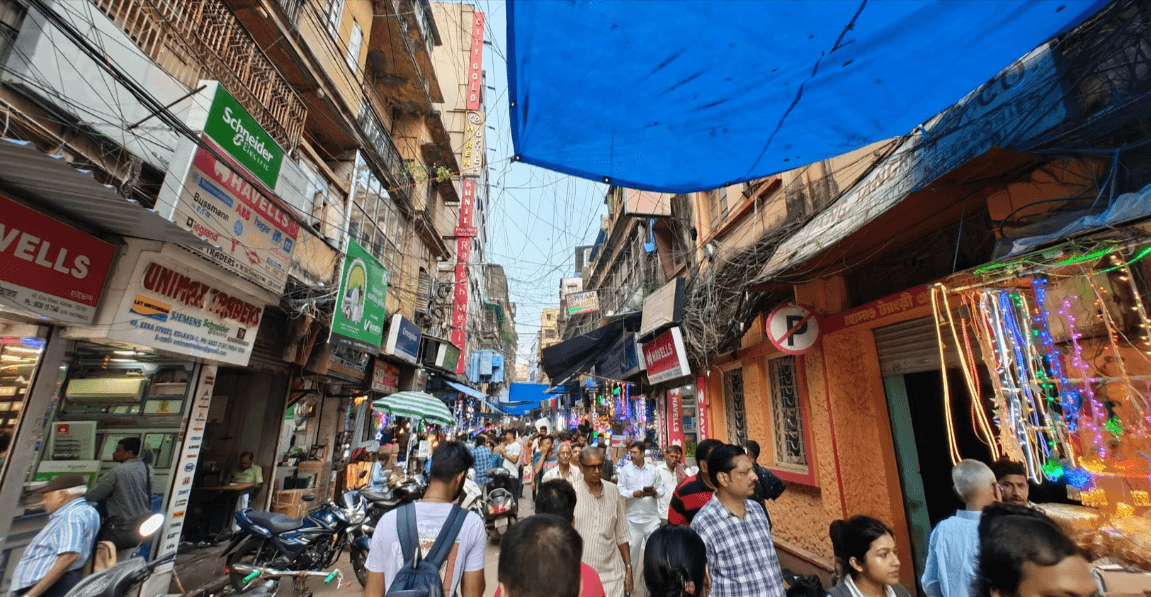
Ezra Street is a historic 350-metre commercial street in Burrabazar, in the heart of Kolkata, famous today as the city’s premier wholesale Lights Market. Named after one of Calcutta’s wealthiest Jewish merchant families, it carries a layered history that stretches from the city’s 18th-century origins, through its Jewish and Parsi mercantile heyday, to its present-day identity as a chaotic, vibrant wholesale trading hub.
Details Overview : Ezra Street
| Detail | Information |
|---|---|
| Name | Ezra Street |
| Location | Burrabazar, Kolkata, West Bengal |
| Length | About 350 metres |
| Original Name | Doomtullah (appears in Mark Wood’s 1784 map of Calcutta) |
| Named After | Elias David Ezra, in memory of his father David Joseph Ezra |
| Known For | Wholesale Lights Market — chandeliers, electrical fittings, decorative lighting |
| Key Landmark | Maghen David Synagogue (built 1884) |
| Other Landmark | Site of the city’s first Parsi fire temple, at 26 Ezra Street |
| Area | Burrabazar — one of Kolkata’s largest and oldest wholesale market districts |
History
Before it became Ezra Street, this stretch of road was known as Doomtullah — likely named after the Doms, a community traditionally associated with cremation work — and it appears under that name on Mark Wood’s 1784 map of Calcutta.
The transformation began in the 19th century, when David Joseph Ezra, one of the wealthiest members of Calcutta’s Baghdadi Jewish community, invested his trading profits in prime city real estate, including this street. According to historian P. Thankappan Nair’s A History of Calcutta’s Streets, the road was ultimately named after David’s son, Elias David Ezra, rather than David himself. Elias held ownership of buildings at 59–62 Ezra Street and left an outsized mark on the city — he’s also linked to Esplanade Mansions and Chowringhee Mansion.
The street became a hub for two of Calcutta’s prominent mercantile communities. On one end stands the Maghen David Synagogue, built in 1884 by Elias David Ezra in memory of his father — described as one of the grandest synagogues in the East. A Beth El Synagogue also has roots connected to the street. Nearby, the building at 26 Ezra Street housed the city’s first Parsi fire temple (Rustomjee Cowasjee Banajee Agiary), reflecting the Parsi community’s own deep commercial presence in the area.
Over time, as Kolkata’s Jewish population dwindled from a peak of over 6,000 in the mid-20th century to around 30 today, Ezra Street’s residential and religious character gave way to intense wholesale commerce — eventually crystallizing into its present identity as the city’s go-to Lights Market, part of the sprawling Burrabazar trading district.
Location
- Ezra Street sits within Burrabazar, one of Kolkata’s oldest and largest wholesale market districts, in the Central division of Kolkata Police jurisdiction
- It’s centrally located near other historic Kolkata landmarks and commercial streets within Burrabazar
- The Maghen David Synagogue marks one end of the street
Connectivity
- By Metro/Rail: Burrabazar is served by the Kolkata Circular Railway, with a station in the area
- By Road: Centrally located within old Kolkata, reachable by taxi, auto, or bus from across the city
- On Foot: Given its short 350-metre length and the dense, narrow trading-lane character typical of Burrabazar, the street itself is best explored on foot once you arrive
- As with much of Burrabazar, expect congestion — the area is known for heavy foot and vehicle traffic typical of Kolkata’s historic wholesale districts
Route
- A typical visit starts at the Maghen David Synagogue end of the street, taking in this striking 1884 landmark
- From there, continue down the street through its dense cluster of lighting and electrical-fittings wholesalers, where shops spill into each other with chandeliers, decorative lights, and fittings on display
- The site of the old Parsi fire temple at 26 Ezra Street is another point of historic interest along the way
- Given Burrabazar’s sprawling, interconnected lanes, many visitors combine an Ezra Street trip with exploration of the wider Burrabazar wholesale market
Top Things to Do
- Browse the wholesale lighting shops — chandeliers, decorative lights, and electrical fittings in every style and price range
- Visit the Maghen David Synagogue, a striking reminder of Kolkata’s Jewish heritage
- Seek out the site of the city’s first Parsi fire temple at 26 Ezra Street
- Soak in the atmosphere of porters, bargaining traders, and glowing light displays — a classic old-Kolkata wholesale market experience
- Combine the visit with nearby Burrabazar exploration and, if interested in Jewish Kolkata heritage, Nahoum’s confectionery in New Market, founded in 1902 by the city’s Jewish community
Retail
Ezra Street’s defining retail identity is as Kolkata’s biggest wholesale Lights Market:
- Dozens of shops specializing in chandeliers, decorative lighting, electrical fittings, and lamp fixtures
- A wholesale-pricing environment geared toward bulk buyers, electricians, contractors, and retailers sourcing stock, though individual shoppers can browse too
- The broader Burrabazar area around it adds further wholesale categories — textiles, hosiery, and general goods — making it easy to combine shopping categories in one trip
- Expect a dense, high-energy trading environment rather than a leisurely retail experience — bargaining is part of the culture here
FAQ
Q: What is Ezra Street famous for?
A: It’s Kolkata’s premier wholesale Lights Market, known for chandeliers, decorative lighting, and electrical fittings.
Q: Who is Ezra Street named after?
A: Elias David Ezra, a prominent member of Calcutta’s Baghdadi Jewish community, who named it in connection with his father David Joseph Ezra’s real estate holdings there.
Q: What was the street called before?
A: Doomtullah, as recorded on an 1784 map of Calcutta.
Q: How long is Ezra Street?
A: About 350 metres.
Q: What historic landmarks are on the street?
A: The Maghen David Synagogue (built 1884) at one end, and the site of the city’s first Parsi fire temple at 26 Ezra Street.
Q: Is Kolkata’s Jewish community still present there?
A: The community has dwindled to around 30 people citywide today, though landmarks like the synagogue remain as a testament to their historical presence.
Q: Is it good for individual shoppers, or just wholesale buyers?
A: While it’s primarily a wholesale market, individual shoppers can browse and buy, especially for lighting and electrical fittings.
Q: What’s nearby?
A: It’s part of the larger Burrabazar wholesale district, with easy access to other historic Kolkata markets and Jewish heritage sites like Nahoum’s in New Market.