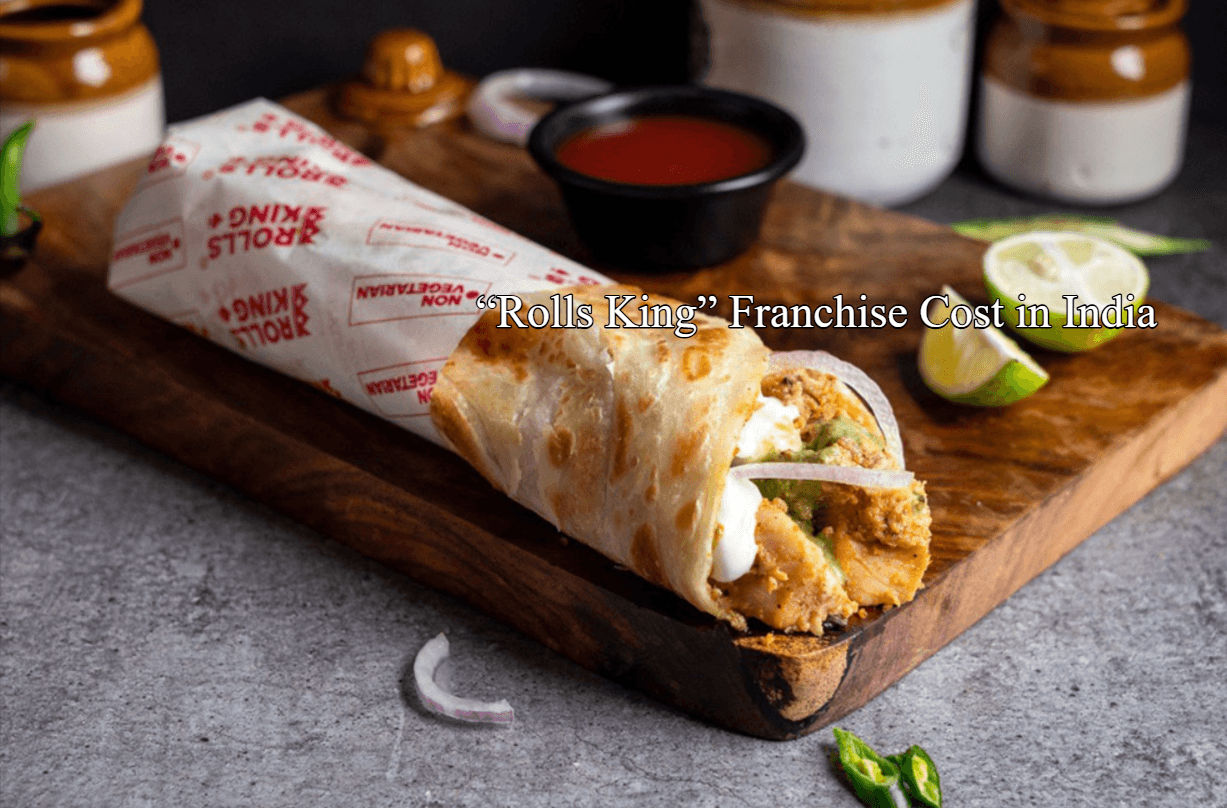
If you’re looking to enter this QSR (Quick Service Restaurant) business in India and a brand which specializes in kathi rolls and street food and street food, it’s possible that Rolls King is a name worth considering. In this blog, which is compiled from trusted and public sources, as well as practical information on the franchise model used by Rolls King, estimated investment/costs and anticipated returns (ROI) and eligibility requirements for partners, as well as the steps to follow for applying.
Why should you consider a King Franchise with Rolls King franchise?
- Rolls King is a niche QSR company that is focused on roll-kathi-roll models (and related fast-food) which has good popularity among college students, young people, malls, high-streets, and other locations. One example mentions that “Rolls King has in the last a few years will become a major company known by its… was founded in the year 2011 … Roll in with the notion of serving the kathi roll …”
- The investment required to start a business appears low compared to other full-service restaurants. This makes it accessible to those who are looking to become entrepreneurs.
- This format is suitable for smaller size stores (sometimes between 100 and 250 sq.ft) which means less rental and real estate burdens at the appropriate location.
- With a well-located location, a strong management and a strong brand with a strong management team, the return on investment and profits are looking promising.
However–as with all franchises–the success will hinge greatly on location, footfall, rent & lease terms, efficient operations, and brand-support/compliance.
Franchise Model How Rolls King Structures It
This is how this brand is attempting to present its franchise offerings according to the data available and practices that are standard:
- The business model is Franchise-Owned/Franchise-Operated (FOFO) meaning you as the franchisee will invest in the operation, manage the store and follow the company’s rules.
- Franchise fee: You pay an upfront cost to get the right to use the brand’s name system, training, etc.
- Investment in setup: get a site (lease/own) as well as execute kitchen equipment, interiors signage, staff etc.
- After launch, you pay a portion of your gross sales (or a fixed amount) towards the franchisee to continue assistance, support and marketing and brand use. One source, for example, lists 5percent of sales.
- Size of the store varies according to the format, however, the most commonly cited requirements for size are 100-250 sq.ft for smaller formats.
- Term of agreement: usually 5-years (renewable) that is standard for the food-franchise industry in India.
- Location criteria: High footfall areas, near colleges/offices/malls, street-front in commercial/residential zones. A source older than the time of this article mentions Rolls King “800-1200 sq.ft” for various formats.
In essence, you put in the money in the brand, follow its system Get assistance (training or supply chain) to start your store and pay for royalties and reap the benefits of the brand’s reputation and marketing.
Cost and investment What are the requirements to begin
Here are the most accurate estimates based on reliable sources that are broken down, and accompanied by an explanation.
investment range
- According to one report: Rs10 lakh to 20 lakh as a range of investment for an Rolls King unit (covering franchise/brand cost, setup, stock) in a 100 to 250 sq.ft layout.
- A different (older) source offers the following investment amount that is 28 lakh for an “restaurant version” of Rolls King with ~800-1200 sq.ft area.
- Another article estimates between between Rs15 lakh and Rs25 lakh total investment (depending the store’s location, size and location).
To summarize the following: for a kiosk in a smaller take-away model in a suitable however moderate area, you may spend Rs10-20 lakh. For larger formats (restaurant model) it could cost Rs25-30 lakh or more, depending on the location.
Common cost components
- Franchise/Brand Fee at least Rs2 lakh (or more) per store in a smaller size.
- Setup costs (interior furniture, kitchen equipment, furniture and signs): could be 3-10 lakh based on dimensions and finishes.
- Initial Materials Stock/Inventory + Working capital and costs prior to opening in the range of a few lakhs. An example from a source that includes “restaurant model” investment breakdown, which includes franchise fees of Rs15 lakh, the cost for setting up Rs 5 lakh, machinery and equipment at Rs2 lakh, and so on.
- Royalty/Commission 5 percent on revenues (in less compact investment formats).
- Rent or real estate Although it is not listed as a part of the breakdown of investments from all sources, this is one of the most frequent expenses. Location and size will decide the viability of your investment in large part.
Table of examples
| Item | (Rs) (Rs) |
| Brand/Franchise fee | ~2 lakh – 6 lakh+ |
| Setup (interior Equipment, interior) | ~3 lakh – 10 lakh+ |
| Initial inventory and working capital | ~1 lakh – 5 lakh |
| Total conservative investment (small format) | ~Rs10 lakh – Rs20 lakh |
| Total larger restaurant model investment | ~Rs25 lakh – Rs30 lakh+ |
Important caveats
- These figures are estimations of third party listings. Always request from the franchisor the official disclosure for franchises with the exact numbers for your location/city.
- Your place of business and store’s format (takeaway or dine-in) or location (Tier-1 or Tier-2) and rental conditions can significantly impact the cost of investment and operation.
- A buffer of working capital is vital. The first few months might see lower sales as you increase your production.
Pay-back and ROI What can you expect from HTML0?
The sources are:
- One site estimates return on investment (return on capital) in one to two years for an investment of 10-20 lakh model.
- Another article: Using assumed margins and sales of Rolls King: e.g. If the gross revenue is Rs.3,00,000 per month, the net profit could be Rs30,000/month (for the assumptions of cost) and margins 10 percent at the beginning and with growth margins, could reach 19 percent.
- Source: “Total investment … payback time of 1-2 years.”
What determines ROI
- Volume of sales (footfall average spend): High footfall places (malls high-streets and malls zones) boost sales.
- Control of costs Particularly the cost of staff and rent as well as wastage of raw material as well as utilities.
- Format and size of the store Format and size: Smaller formats that have effective use could pay back faster, while dine-in formats may be slower.
- Marketing / Brand support Support from the franchisor, and a strong local marketing can increase the number of admissions.
- Recurring customers/delivery tie-ups with food delivery platforms and pedestrian traffic, the mix can be a factor.
- Operations Speed of service hygiene, speed, menu refresh is a factor in QSR.
Practical perspective
If you invest ~Rs15-20 lakh in a decent location; assume you can get say Rs3-5 lakh/month gross sales (depending on city/format), with net margin say 15-25% (after all costs) you might earn ~Rs45,000-Rs1,25,000/month. If you earn that much, you can repay your investment in 12-24 months (depending on reinvestment, amortisation or additional costs). However, note that this is an optimistic estimate and under less favorable circumstances, the payback could take 3 to 5 years.
Eligibility Who is eligible to be a partner
If you are applying an application for the Rolls King franchise you should be able to meet the following criteria:
- Good ability to manage finances Ability to invest capital and begin the initial month without huge losses.
- suitable lease/real estate The property must already have, or capable of securing an area with a high amount of foot traffic and within one of the brands acceptable sizes, that meet the specifications for size (100-250 sq.ft for a smaller model or more for larger models) as per the quoted.
- Food service or retail experience is advantageous (though some brands may permit newcomers who have a committed commitment).
- In line with the brand’s operational standards Hygiene, service branding, training compliance.
- Willingness to adhere to the brand’s SOPs, train, and be a part of local inventory and marketing methods.
- A commitment to manage the store (or engage a qualified manager) and oversee operations with a clear focus.
Format and location specific
Given the size requirements and brand’s focus on QSR/rolls, ideal locations include: shopping malls, food courts, college/office clusters, high-street commercial/residential intersections. A smaller take-away kiosk located in an area with high traffic could be less costly and easier to start, but it will require a careful decision-making about the location.
Steps to follow: A practical guide
This step-by-step procedure will allow those who want to be a franchisee for an application for a Rolls King franchise:
- Self-assessment of the initial self-assessment
- Determine your budget and investment capacity.
- Select the city/town of your choice, and then choose the best design (take-away kiosk vs dine-in outlets).
- Explore possible locations and rent/lease conditions (expect areas with high footfall).
- Examine your work experience in terms of management bandwidth, your business experience, and the state of your business.
- Research and short-list information about franchises
- Visit the official Rolls King Franchise page(s) or get in touch with the team that develops franchises. For instance, the page on FranchiseIndia provides more information.
- Request the latest Franchise Information Pack that includes Cost breakdown, royalty/commission terms Support package, approved formats, territories rights, length of the agreement.
- Create application and documentation
- Make your business profile. Include Personal background and investment capacity, your desired location, your team/manager should you need to.
- Include any previous food or retail business experiences (if there is any).
- Include information about the proposed site address location, lease status, photos of the size, expected rent.
- Provide the necessary identification and financial documents that the franchisor can review.
- Site evaluation & interview
- Rolls King team will evaluate the area (footfall and the visibility, competition, accessibility).
- Interviews are conducted to evaluate your suitability, operational plan, and willingness to keep the standards of your brand.
- The franchisor could propose changes or accept the structure (takeaway/kiosk or restaurant) in accordance with the location.
- Contract and payment
- Review the franchise agreement carefully: investment schedule, franchise fee, royalty/commission %, territory/exclusivity clause, duration of agreement, renewal terms, termination clause.
- First payment to be made (franchise fee) according to the terms of agreement.
- The agreement will be signed once the parties are in agreement.
- Training and setup of outlets
- Purchase or lease of property.
- Install the store according to the standards of the brand’s equipment and interior (design signs and kitchen layout).
- Hire employees (cooks or service) and train them via Rolls King training program (brand should offer training in food preparation and service, inventory sanitation, etc.).
- Arrange initial inventory, POS systems, packaging, menu, marketing launch plan.
- Soft launch and full launch
- Make a soft opening to try out operations, get feedback, and refine processes.
- Start a marketing and advertising campaign (local promotions or social media), and possibly collaborations using delivery applications).
- Check the operation closely Inspect sales, waste productivity of staff, sales speed.
- Growing and ongoing operations
- Follow the brand’s SOPs, ensure the quality, track costs and profits.
- Track KPIs: average transaction value, sales per sq.ft/day, labour cost %, food cost %.
- Consider opening additional outlets or alternative formats, if the primary one performs well.
Practical tips and tips for avoiding dangers
Tips
- Select the right location for a roll/kathi-roll QSR, it is best to be near colleges and food court areas that are crowded with shoppers commercial clusters are helpful.
- Negotiate leases and rents Rent is often what makes or breaks the profits in retail food; make sure you negotiate favorable terms through the ramp-up or fit-out assistance.
- Concentrate on the cost of food as well as kitchen efficacy QSR margins are very tight control of food costs is essential. Also, the speed of service is crucial.
- Make use of delivery and online drives Integrating food delivery systems and local online marketing can generate additional income.
- Learn about the royalty/commission structure It is important to incorporate this into the financial modeling.
- Build buffer to start the initial months The first 3 months might be slower while you establish brand recognition locally. You should plan your working capital in line with.
Red flags / warning
- If the franchisor demands huge hidden fees, or fails to divulge the royalty or marketing contributions in clear terms.
- If the proposed location has extremely high rental or low footfall, despite the franchise’s claims.
- If the brand’s support/training seems inadequate or unclearly laid out.
- If the agreement includes a long lock-in time, and severe penalties for leaving, this reduces the amount of flexibility.
- If there’s no information about the actual results of the outlets currently in operation (you must try talking with other franchisees).
Last Thoughts
The Rolls King franchise offers a attractive entry point into the foodservice sector in India particularly for those looking to make investing in a modest amount and an internationally recognized brand in the roll/kathi-roll market. With a range of investment that typically between Rs10 and 20 thousand for smaller formats, and possible higher for dine-in models as well as a model of business that, if done effectively–can yield a return within 12–24 months this is an opportunity that is worth considering.
But it’s not an automatic process. Important factors include choosing the right location and limiting costs (rent or food expenses as well as labor) and efficiently managing the operation and using brand-specific training and support. Before signing a franchise agreement, get the franchise agreement by Rolls King, model your finances conservatively, and read the agreement thoroughly (ideally together with legal advice) and make a clear strategy for month-to month operations.