The sector of early childhood education in India is on the rise due to the growth of dual-income households, an increasing understanding of the importance of early learning and an ever-growing urban and urban and peri-urban populations. If you’re looking to enter the industry and a preschool franchise is a good option, it’s an exciting business opportunity. In this blog I’ll explain the ways that preschool-related franchises across India operate: the amount of amount of investment needed, the anticipated ROI, eligibility requirements as well as the step-by-step procedure to apply. This will include reliable industry sources and information from my own experience as a content writer for a business franchise.
Why Consider a Preschool Franchise?
There are several reasons why preschools/franchised play-schools are attractive:
- The Indian early elementary education market is predicted to grow at an enviable pace.
- The brand (franchise) model offers an established curriculum that includes brand recall, operational support, marketing and admissions procedures that lower the risk when compared with setting up your own preschool.
- Fixed-space business, a regular month-to-month fee structure (tuition) aids in the regular cash flow.
- For a number of brands, the initial investment is not as high when compared to other big businesses, like retailers or schools for children.
However, the likelihood of success is heavily contingent on the location, the high-quality operations as well as brand recognition and also establishing admissions. A forum user said it:
“Its extremely fiercely competitive… you have to invest in marketing via digital … where you are and fees as well as how you manage your business.”
Let’s take a step-by-step approach.
Franchise Model: How Preschool Franchises are Structured
Here’s a basic model to follow:
- The franchisee brand includes a proven program, brand name and signage and teacher training, as well as marketing assistance (parent-reach) and operations manual, guidelines for interior design and, occasionally, software/ERP.
- The franchisee (you) provide: the premise (own/lease), required classroom space and outdoor/play area, local staffing, day-to-day management, admissions/acquisition of students, and compliance (safety, licenses etc).
- Most of the revenue comes from tuition or fees from children. Some models might include additional revenue streams such as daycare or extended hours, sports classes as well as summer camps.
- Commercials differ: one-time franchise fee plus initial setup costs plus continuing royalty or marketing contributions (in certain models) or, in some cases, there is no royalty.
- For instance, some brands provide without licensing models.
- Others pay a royalty or a the percentage of fee revenue.
- The typical term for agreements is three to five months (renewable). Support for the brand continues throughout the duration of.
Price & investment: How much have to consider when planning your plan for
The amount of money you invest varies based on the brand, the city (metro and Tier-2/Tier-3) and the size (student intake capacities) space, as well as the finishes. Below are the most realistic investment options and what they comprise.
Cost ranges typical
- According to KinderNext the setting up of the preschool franchise in India generally costs between 15 and 25 thousands for a complete set-up.
- For smaller brands or simple configurations, one brand provides prices starting at 6-10 lakhs (2,000 sq ft) for their product.
- Certain budget models call for the investment to be at as little as Rs3.99 lakhs (rural/semi-urban) for smaller installations under specific brands.
Cost components typically comprise
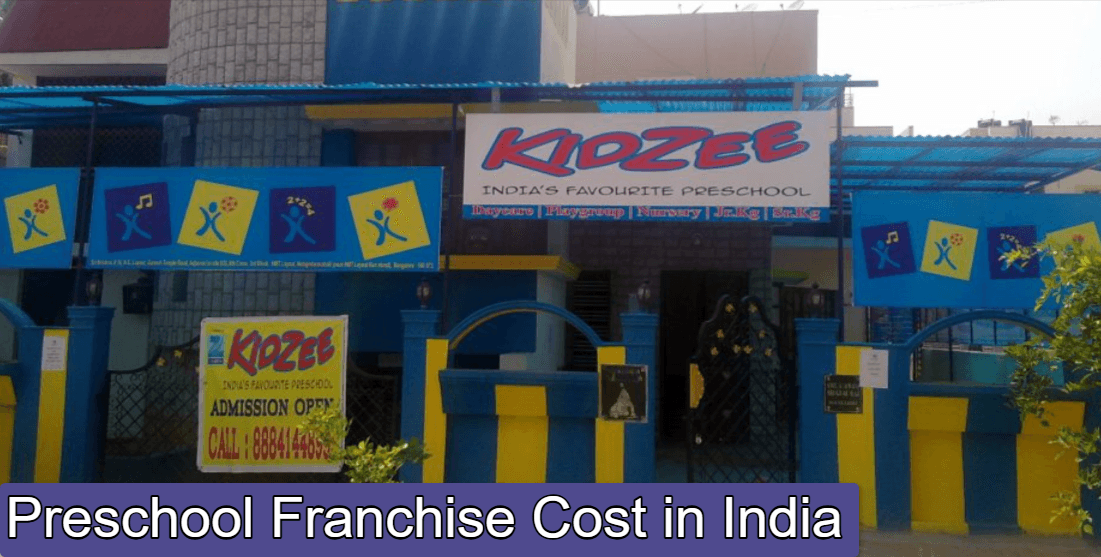
- Franchise/brand fee (one-time). E.g. For top brands such as Kidzee The breakdown of investments provides information on brand/fees, infrastructure etc.
- Building/fit-out/interiors: classrooms, play area, furniture, toys, educational kits.
- Play/outdoor area or activity space (for preschoolers, where parents prefer playing).
- Staffing: Recruiting trained early-childhood teachers and the support staff.
- Marketing & initial admission drive.
- Working capital to fund the initial couple of months while admissions begin to increase.
- Legal compliance, licensing, safety, etc.
Examples of numbers
From a single label (Kidzee):
- Investment: ~Rs12-25 lakhs depending on location & size. Franchise fees Rs2.5-5 lakhs. Equipment and infrastructure cost between 8-10 lakhs, furniture/toys cost Rs4-6 lakhs, marketing and working capital up to 1-4 lakhs.From another brand with a budget (WowKids):
- Rural and semi-urban: Rs3.99 lakhs including setup and franchise fee Urban Rs4.99 lakhs. (Small size)
Size / space requirements
- A variety of brands recommend approximately 1,500-3,000 sq.ft constructed-up space (with an additional play space) to provide a complete preschool.
- Smaller models can run on between 1,000 and 2,000 sq.ft particularly in semi-urban and rural areas.
Summary Table
| Band | Range of investments | The typical size of a city |
| The budget model (small town/rural, with smaller capacity) | Amount of Rs. 3 lakhs | ~1,000-2,000 sq.ft |
| Mid model (town/metro smaller intake) | The amount is between Rs8 and 15 lakhs. | ~1,500-2,500 sq.ft |
| Full model (metro, large intake) | Amount of Rs15-25 Lakhs (or more) | ~2,500-3,000+ sq.ft |
Expected ROI & Breakeven
Knowing how fast you can make a profit and what return you can anticipate is vital.
- In this article, an industry insider describes how a preschool franchise model may break-even in 5-6 months in ideal circumstances (strong locations, enrollments) however realistic expectations should allow for 12-24 months.
- A single listing (SmartKidz) for instance, estimates ROI of 40-50% annually and break-even time of 12-18 months according to their plan (invest between Rs6-10 lakhs).
- Another view: With an investments of between 15 and 25 thousands (Kidzee/EuroKids class) with a ROI of 2-3 years, a monthly profit of Rs60,000-Rs1.2 million (depending on the capacity and fees) located in a prime metro area.
The most important factors that affect ROI
- The location and the catchment area: a dense residential area that has young families boosts enrollment.
- Capacity and structure of fees Higher tuition and close to full enrollment = faster return.
- Rent personnel salaries, marketing consume margins.
- Marketing/admissions and brand reputation drive.
- Additional options like daycare, afterschool programming weekends activities, and afterschool programs can increase the revenue.
The rule of thumb is: If you secure an ideal location, handle admissions/marketing effectively and manage costs effectively it is possible to return investment within 2 to 3 years and then make sustainable profits.
Eligibility Criteria and What do franchisors search for
If you are applying for an educational franchise, the franchisors usually evaluate:
- Financial ability: the capacity to invest the capital needed and funds to last for the first months.
- Your business skills: the ability to manage an education-related business know the local market, parent-community relationships.
- Access to a suitable premise: either you have a lease/own building in a good location (residential neighbourhood/community) or can secure one quickly. E.g. Many brands require more than 1,500 sq.ft in residential areas.
- A commitment to the standards of the brand Safety, staffing play area, education and audits.
- For certain brands, a an education degree is preferred (though franchisees usually collaborate with a person who is strong in the field of education). Example: SmartKidz requires minimum graduate educational qualification.
- Your local marketing and networking network admissions depend upon the reputation of your local area and referrals from parents.
Application Steps: Apply to your road map
This step-by-step guide will help you to apply for and launch the preschool franchise.
- Shortlist and research brands
- Compare multiple preschool franchise brands: investment, royalty/fee, support, track record.
- Request a franchise disclosure package What support is provided as well as what your obligations are as well as the minimum enrollment targets territory rights, renewal policies.
- Self-assessment and location planning
- Review your budget and your ability to commit your time and effort.
- Find potential areas such as areas of residential with young families, or planned housing developments that are easily accessible and secure.
- Estimate the rent as well as local competition.
- Contact us for initial contact and inquiry
- Visit the websites of brands (many offer franchise inquiry form) and fill in your information (investment capacity, location/city and business profile).
- Brands will reach out to you to inform you of the franchise’s model of franchising, details on investment and the support they provide.
- Submit formal application & evaluation
- You must provide proof of identification, proof of financial status and business records (if there’s any) as well as the location you are proposing to use.
- Franchisor will conduct feasibility checks of your site’s proposed location and local demand, as well as the demographics of the area.
- Commercial negotiation & agreement signing
- After approval, you’ll be provided with a contract covering the franchise fee as well as royalty (if there is any) as well as the duration (3-5 years) territory rights, and a set-up schedule.
- Examine the agreement thoroughly — make sure you are negotiating terms like royalty percentages, exclusivity of territory renewal fees, etc.
- The franchisee must pay the fee, and then he has to sign the agreement.
- Establish a centre
- Secure the building by leasing or securing it, including interiors, play space, furniture, educational kit according to the guidelines of the brand.
- You must obtain the necessary permissions or licenses (local business license, perhaps regional ECE laws).
- Train staff and recruit teachers using the brand’s education program.
- Admission drive and marketing Launch campaign to enroll the students in the first cohort of.
- Make sure that children are safe, have a child-friendly environment Signage, branding, and other requirements according to the your franchisor.
- Launch and run
- Open doors, commence classes.
- Monitor admissions, retention, parent-engagement, curriculum delivery.
- Make use of the brand’s support for software, marketing and parent-apps.
- Monitor performance every month: enrollments fee collection, enrolments, budget control and prepare for other revenue streams (e.g. daycare, extra-curricular).
- Review and scale
- After a stable operation, you can think about increasing the capacity (additional rooms) or establishing a second facility.
- Examine key metrics such as occupancy rate, cost per student, staff costs and rent cost — find the best way to maximize for a an acceptable margin.
Additional Practical Tips & Red Flags
Tips:
- The location is important When it comes to preschool business, parents seek ease of access and confidence. A secure and easily accessible area for their home can help.
- Brand vs. cost A budget-friendly investment can be tempting but a brand that is weaker could be unable to draw parents. A well-known brand can charge more and get children enrolled faster.
- Marketing prior to opening Make sure you are aware in the early days (3-4 months prior to the opening) Tours to parents and children, an open houses Social media, local leaflets.
- Multi-income streams In addition to the normal fees, you could also consider daycare for children in the midday and summer camps, or weekends activity clubs.
- High-quality staff and environment Word of mouth counts a lot when it comes to preschools. If parents are satisfied they will keep their children in good hands.
- Manage costs Rent and staff wages, as well as utilities can impact margins -be sure to make sure you model your P&L cautiously.
Red Flags:
- If the franchisor offers an unrealistically large return on investment or break-even within a little time, but does not provide any evidence.
- Hidden royalties or marketing costs which are not disclosed.
- Lock-in time is very long and comes with severe penalties for early departure.
- Franchisees are required to purchase expensive “mandatory” products or kits that do not have a clear cost breakdown.
- The location is not checked or you’re pushed to an unsuitable website.
Final Thoughts
The preschool business franchise option in India is the opportunity for a lucrative potential for business in the field of education that could yield low investment and profitable returns — if you select an appropriate brand choose an excellent location, provide high-quality operations and increase admissions efficiently. In short:
- The average investment is the range of Rs.3 lakhs (very small/rural models) all the way to upwards of Rs15-25 lakhs for metro and high capacity designs.
- Expected break-even typically within 12–24 months and a good return on investment afterward.
- The eligibility criteria emphasizes your capacity to invest in location, your selection of a suitable location, your business acumen and commitment to standards of your brand.
- The steps are: Research – shortlist brands – submit enquiry – evaluation of the site Agreement – setting-up launch and operation.